Definitions, pronunciation and part of speech
A translation tells you what a word maps to. A definition tells you what it means. Since v0.54.0 a saved word carries both, along with how it sounds and what kind of word it is.
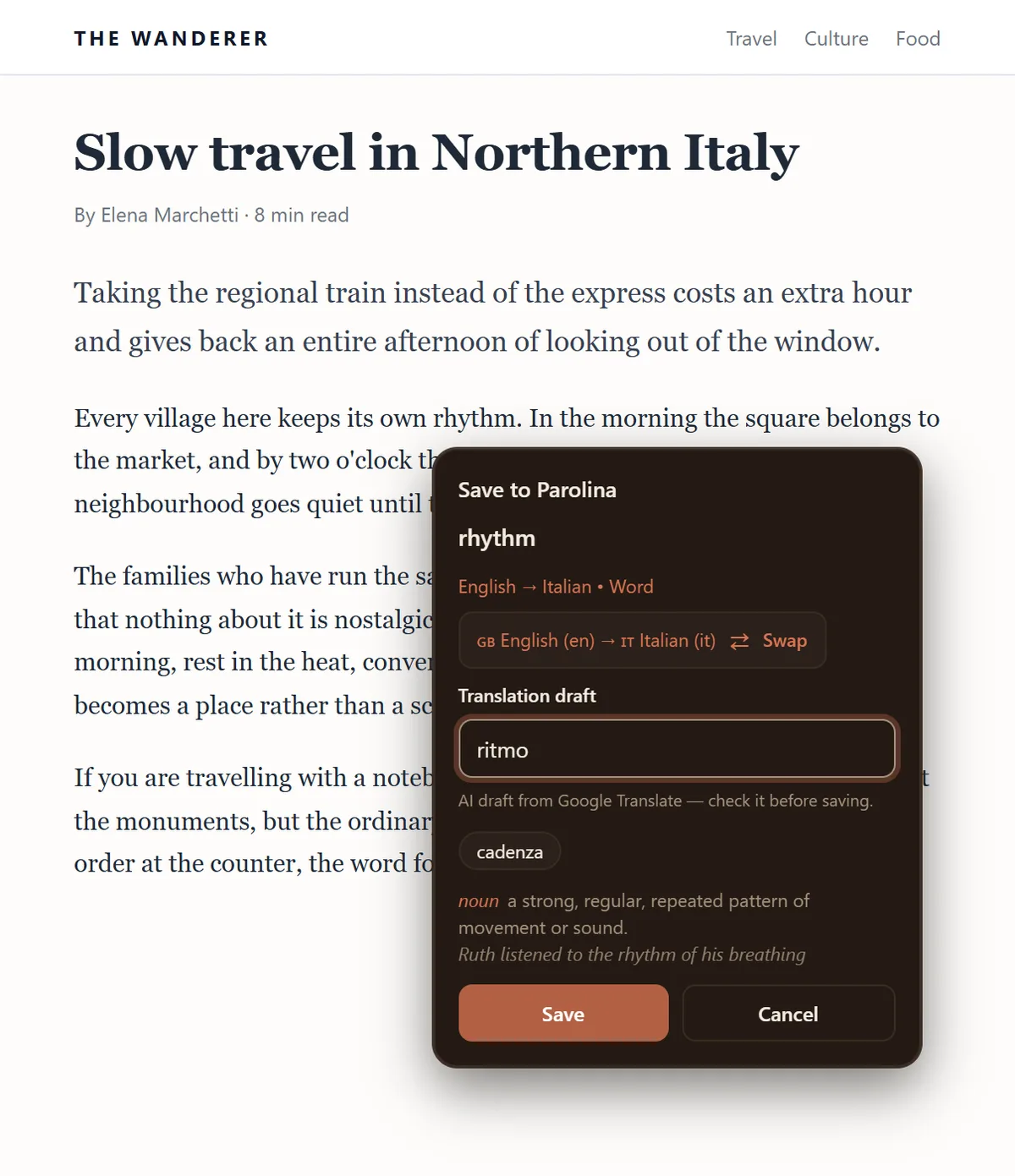
What you get
- A definition in the word’s own language — the way a monolingual dictionary would put it — with an example sentence where one exists.
- Up to two senses per part of speech, so “run” arrives with the verb and the noun rather than two shades of the same verb.
- Pronunciation as a transliteration with stress marks, plus a speaker button that reads the word aloud using your browser’s own speech.
- The part of speech, detected from the translation rather than assumed to be a noun.
Where it comes from
All of it rides the same request Parolina already makes for the translation. No second service, no extra permission, and nothing sent beyond the word you selected. That is also why it is free on every plan: there is no cost to recover.
Why a word sometimes has none
- You saved a phrase or a sentence. Definitions are asked for only when the selection is a single word.
- The dictionary has no entry for it — names, rare inflections and invented words usually come back bare.
- The word was saved before v0.54.0. Older words stay exactly as they were; nothing is rewritten behind you.
Nothing is invented to fill the gap. A word with no definition shows no definition rather than a placeholder — measured on a sample of 24 words across three language pairs, about 96% came back with one and about 79% with an example.